
By Friends of Angola
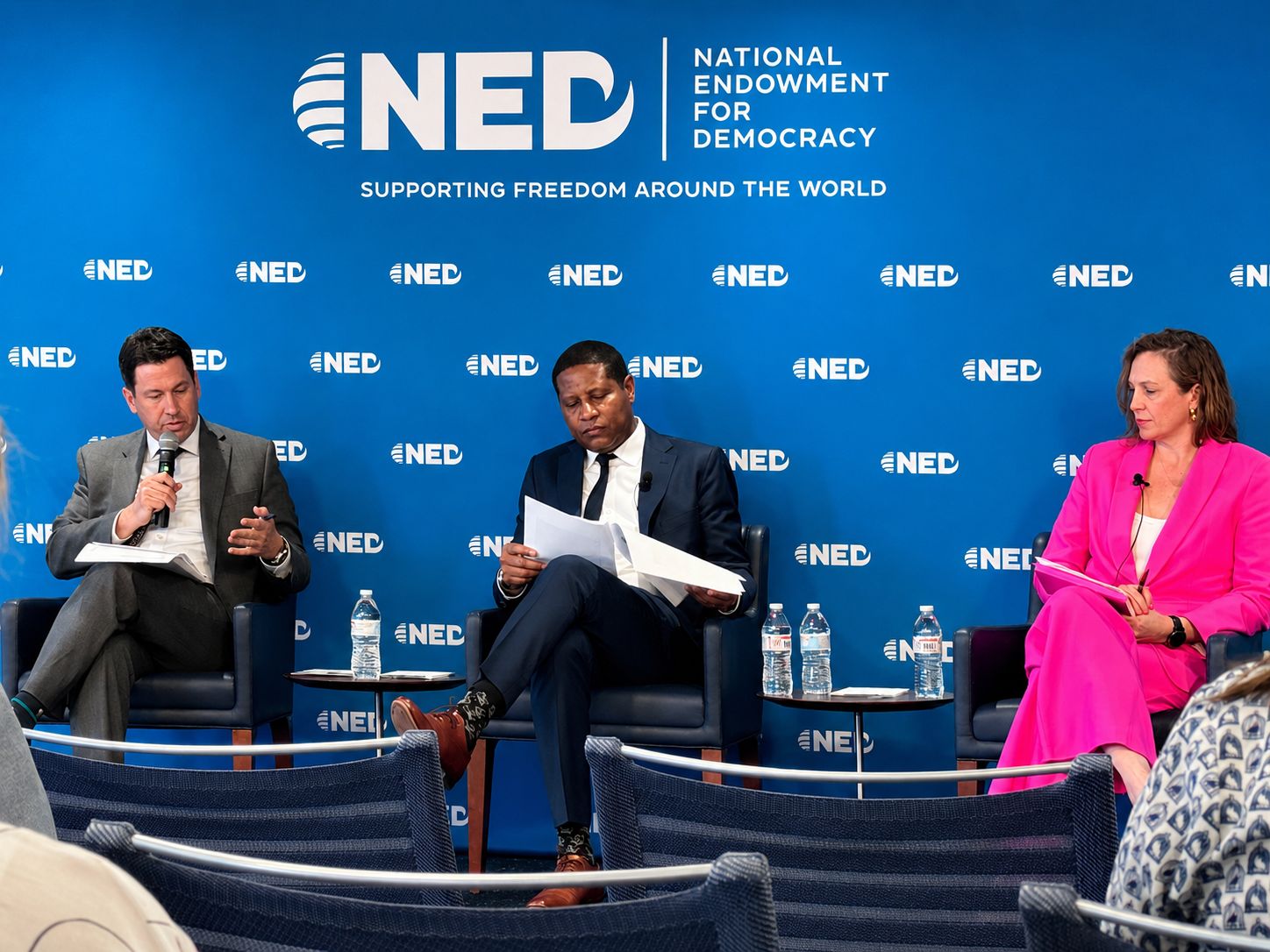
Last week, Florindo Chivucute presented the findings of his research, “Enabling Authoritarianism: How China and Russia Undermine Democracy’s Potential in Angola,” developed as part of the Reagan-Fascell Democracy Fellows Program, a residential fellowship hosted by the National Endowment for Democracy (NED) in Washington, D.C.
The research examines how opaque development financing — particularly through China’s Belt and Road Initiative (BRI) — alongside digital surveillance technologies and information manipulation, contributes to the consolidation of authoritarian governance and democratic erosion in Angola and beyond.
The study argues that these mechanisms function as an “External Accountability Substitute,” enabling governments to reduce their reliance on domestic accountability systems, democratic institutions, and transparent governance practices. In doing so, they weaken institutional oversight, undermine free markets, erode public accountability, and compromise electoral integrity.
Historically, democratic backsliding has often been associated with military coups and overt authoritarian takeovers. However, the research highlights how contemporary authoritarianism increasingly operates through more sophisticated systems of external support. These systems provide financial, technological, political, and security assistance that help sustain authoritarian regimes while weakening both emerging and established democracies.
The findings further explore how external actors exploit governance vulnerabilities in resource-rich but institutionally fragile states, reinforcing kleptocratic systems and limiting civic participation, media freedom, and political competition.
As authoritarian influence expands globally, understanding the role of these external accountability substitutes becomes increasingly important for policymakers, civil society organizations, researchers, and democratic actors committed to defending transparency, democratic governance, and institutional integrity.
Although the full paper is not yet publicly available, a podcast discussing the research and its key findings can be accessed below: https://open.spotify.com/episode/7hhnz9rvJyF4Jfagl2inhr?si=Bs2BT_ecRaWy3cYKKslPdA