By Florindo Chivucute
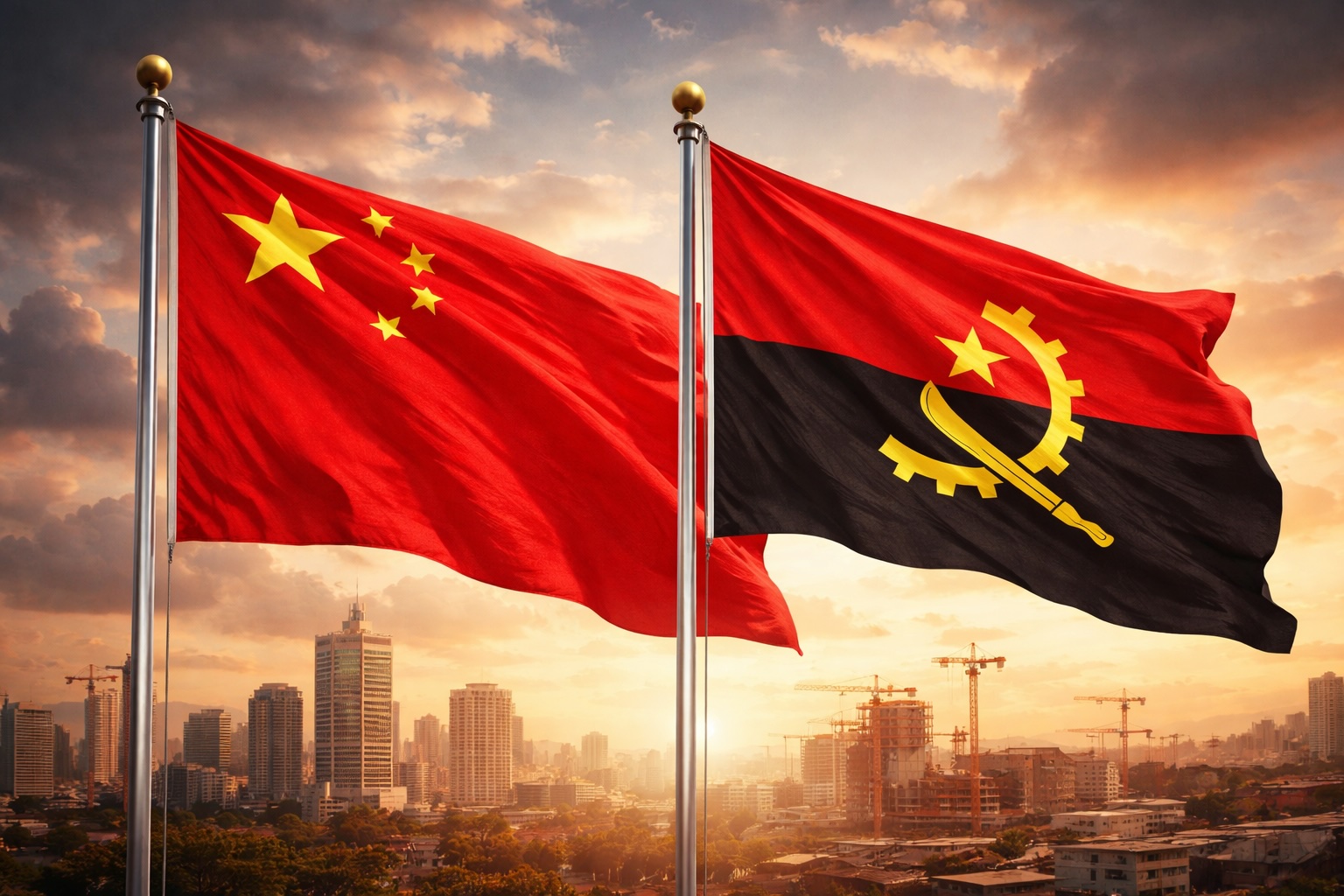
Angola is Africa’s largest recipient of Chinese development financing. Over the past two decades, the country has received tens of billions of dollars in loans, oil-backed financing, and large-scale infrastructure investments. Roads, railways, housing developments, ports, airports, hospitals, and telecommunications networks across the country bear the imprint of Chinese companies and state-owned banks.
Yet for most Angolans, poverty remains a daily reality. More than half of the population lives in multidimensional poverty. According to the World Food Programme, 53% of Angolans survive on less than USD 3.65 per day. Youth unemployment is high, especially in urban areas. Access to basic services such as healthcare, education, electricity, and clean water remains limited. Social inequality is among the highest in the world. According to Afrobarometer, youth unemployment in Angola remains a critical challenge. Approximately two-thirds (67%) of young Angolans aged 18–35 report actively looking for work.
How is it possible that a country that has received so much money for “development” continues to leave its people living under such difficult conditions?
The answer does not lie in a lack of financial resources, but in strategic corruption, weak governance, the absence of accountability, and a development model designed to serve political power rather than ordinary citizens. Chinese financing entered Angola through opaque agreements negotiated with political elites, who used much of these resources for personal and political gain. This enabled a small group to accumulate unprecedented wealth in Angola’s history.
Strategic Corruption: When Corruption Becomes Part of the System
Angola’s development failure cannot be explained by petty corruption alone. What defined the post-war period was strategic corruption, the deliberate use of opaque contracts, unclear financing arrangements, and political control, particularly by the executive branch, over state resources to consolidate power, reward allies, and silence critical voices.
Chinese financing entered and reinforced this kleptocratic system, which continues to dominate Angola’s political economy even after President João Lourenço came to power in 2017 with promises to fight corruption.
Oil-backed loans, negotiated outside public scrutiny, created a parallel decision-making system in which vast sums circulated without oversight by the National Assembly or knowledge of citizens. In this context, corruption was not an occasional deviation, it became a governing method.
Oil-for-Infrastructure Without Transparency
After the end of the civil war in 2002, China rapidly expanded large-scale financing at a time when institutions such as the IMF and World Bank were more cautious. The “oil-for-infrastructure” model allowed Angola to pledge future oil production in exchange for immediate capital.
While this model enabled infrastructure reconstruction, often with quality concerns and inflated costs, it also; (1) reduced parliamentary oversight, (2) limited transparency over contracts and real project values, (3) concentrated decision-making in the executive, and (4) removed major agreements from public scrutiny. This environment allowed strategic corruption to flourish.
Infrastructure Without Impact on People’s Lives
Chinese-financed projects reshaped Angola’s urban landscape but failed to transform the lives of most Angolans. Instead, they benefited political elites aligned with executive power and the ruling MPLA party, in power since 1975.
Many projects linked to China’s Belt and Road Initiative relied heavily on imported Chinese labor and materials, generated few sustainable jobs for Angolans, transferred minimal technical skills to local communities, and failed to integrate domestic supply chains.
The result has been development without inclusion, visible infrastructure with little impact on human well-being. Political symbolism outweighed improvements in living conditions.
Debt as a Political Instrument
In Angola, public debt is not only an economic issue—it is also a political tool. Chinese loans fed a system in which state resources remain controlled by elites, oversight institutions are weak or subordinated, and civil society and media face restrictions.
While loan benefits were privatized, debt obligations were socialized. When oil prices fell, austerity followed: social spending cuts, currency devaluation, and deeper hardship for Angolan families.
Thus, development finance became a mechanism for elite enrichment, internal political survival, and external political access, particularly for China.
The so-called “Angolan paradox,” massive financing alongside widespread poverty is not a mystery. It is the predictable outcome of strategic corruption, weak governance, and lack of accountability.
Until development is anchored in transparency, democratic oversight, and strong institutions, Angola will continue borrowing billions while its people struggle to survive.
The real question is no longer who finances Angola, but whether Angola is willing to dismantle a system where development serves political elites and external interests rather than the Angolan people.
About the Author
Florindo Chivucute is the Founder and Executive Director of Friends of Angola (FOA), a U.S. based organization dedicated to promoting democracy, human rights, transparency, and good governance in Angola and across Africa. He holds degrees in Political Science, International Relations, and Conflict Analysis and Resolution, and has worked as a researcher, political analyst, consultant, and sanctions specialist, leading initiatives to strengthen democracy, civil society, and anti-corruption efforts.