Image: Folha
By Friends of Angola
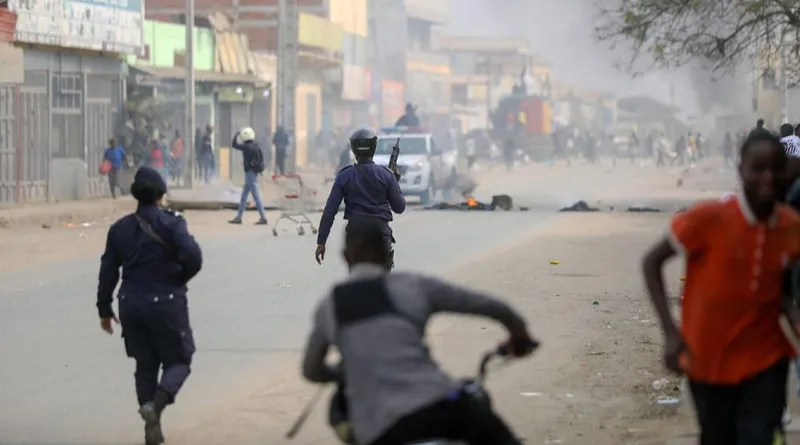
At the end of July 2025, Angola experienced one of the most tragic episodes since the end of its civil war. Between July 28 and 30, a nationwide taxi drivers’ strike, triggered by rising diesel prices and the worsening cost of living, evolved into a wave of social protests that ended in a violent crackdown by the country’s defense and security forces.
One year later, the wounds remain open. The families of the victims are still waiting for answers, Angolan society has yet to learn the full truth, and the State has failed to fulfill its duty to investigate the events, hold those responsible for the violations accountable, and provide reparations to the victims.
The memory of the victims demands more than remembrance. It demands truth. It demands justice. It demands accountability.
What Happened?
Between July 28 and 30, 2025, thousands of citizens took to the streets in Luanda and other provinces to protest the rising cost of living following the partial removal of fuel subsidies and the resulting increase in public transportation fares.
Although incidents of vandalism and looting occurred in some areas, numerous national and international organizations reported that the response of the security forces was characterized by the disproportionate use of force, including the use of live ammunition against civilians, arbitrary arrests, and alleged extrajudicial executions.
These events constituted one of the most serious human rights crises recorded in Angola in recent decades.
How Many People Died?
One year later, there is still no consensus on the number of people who lost their lives.
The Government of Angola officially reported that the events resulted in 30 deaths, 277 injuries, and more than 1,200 arrests.
However, in February 2026, UNITA’s Shadow Government published the report Deaths and Human Rights Violations During the July 2025 Uprising, concluding that at least 90 people were killed during the crackdown.
According to the report, the victims were identified in six provinces:
- Luanda: 47 deaths
- Malanje: 20
- Lunda Norte: 9
- Huambo: 8
- Cuando Cubango: 5
- Huíla: 1
The report concludes that many of these deaths resulted from the excessive and disproportionate use of force by State agents and recommends the establishment of an independent and impartial investigation.
The discrepancy between the official figures and those documented by independent organizations underscores why Angola urgently needs a credible, transparent, and independent investigation.
Civil Society’s Response
Faced with the gravity of the events, Angolan civil society did not remain silent.
On August 5, 2025, Friends of Angola, the Episcopal Commission for Justice, Peace and Integrity of Creation of the Episcopal Conference of Angola and São Tomé (CEJPIC), the Association Justice, Peace and Democracy (AJPD), and Pro Bono Angola held a joint press conference to condemn the violence that occurred between July 28 and 30.
In their joint statement, the four organizations expressed deep concern over the events, denounced alleged summary executions, called for respect for human rights, and demanded an independent investigation to establish accountability.
Subsequently, Friends of Angola also joined a coalition of national and international organizations that submitted a letter to the Secretary-General of the United Nations, calling for the establishment of an Independent International Fact-Finding Mission to investigate the July 2025 events.
What Was Promised?
Following the unrest, Angolan authorities assured the public that the situation would be reviewed and that public order would be restored.
At the same time, organizations including Friends of Angola, CEJPIC, AJPD, Pro Bono Angola, Amnesty International, Human Rights Watch, and United Nations experts called for:
- An independent and impartial investigation;
- Identification of those responsible for the deaths;
- Criminal accountability for those responsible for abuses;
- Full reparations for victims and their families;
- Structural reforms of the security forces to prevent future violations.
What Has Not Been Done?
One year later, virtually none of these recommendations have been implemented.
To date:
- No independent commission of inquiry has been established;
- No official report has been published explaining the circumstances surrounding all the deaths;
- No State officials have been publicly identified or held accountable for the alleged unlawful use of force;
- The victims’ families continue to be denied truth, justice, and reparations.
Meanwhile, hundreds of citizens were swiftly prosecuted and convicted for offenses allegedly committed during the protests, highlighting a troubling imbalance in the administration of justice.
A Pattern of Impunity
The events of July 2025 were not an isolated incident.
Since the end of Angola’s armed conflict in 2002, the country has witnessed several episodes of political violence and repression whose responsibilities remain insufficiently investigated, including the 1992 post-election violence, the Mount Sumi killings (2015), the Cafunfo massacre (2021), and now the violent repression of the July 2025 protests.
Whenever serious human rights violations go uninvestigated and those responsible are not held accountable, a culture of impunity is reinforced, weakening the rule of law and increasing the likelihood of future abuses.
Justice Strengthens the State
Friends of Angola reaffirms that investigating human rights violations does not weaken the State.
On the contrary, democratic states become stronger when they acknowledge their mistakes, hold perpetrators accountable, and ensure that no institution is above the law.
Public trust in government institutions depends on the State’s willingness to protect life, uphold fundamental rights, and ensure justice for every victim.
Friends of Angola’s Appeal
One year later, we renew our call on the Government of Angola to:
- Establish an independent, impartial, and credible commission of inquiry into the July 2025 events;
- Publish the complete list of those killed, injured, and detained;
- Criminally prosecute all those responsible for extrajudicial executions and the excessive use of force, regardless of rank or position;
- Provide full reparations to the victims and their families;
- Implement comprehensive reforms of the defense and security forces in line with international human rights standards;
- Fully cooperate with the United Nations and the African Commission on Human and Peoples’ Rights.
In Memory of the Victims
Regardless of whether the final number of victims was 22, 29, 90, or another figure that an independent investigation may ultimately establish, one fact remains undeniable: dozens of families lost loved ones and continue to live without answers.
The victims deserve to be remembered.
Their families deserve justice.
And Angola deserves to know the whole truth.
Friends of Angola will continue to honor the memory of the victims, demand accountability for the abuses committed, and promote a rule of law in which no one is above the law. Only through truth, justice, and accountability can public trust in Angola’s institutions be restored and tragedies such as those of July 2025 be prevented from ever happening again.