
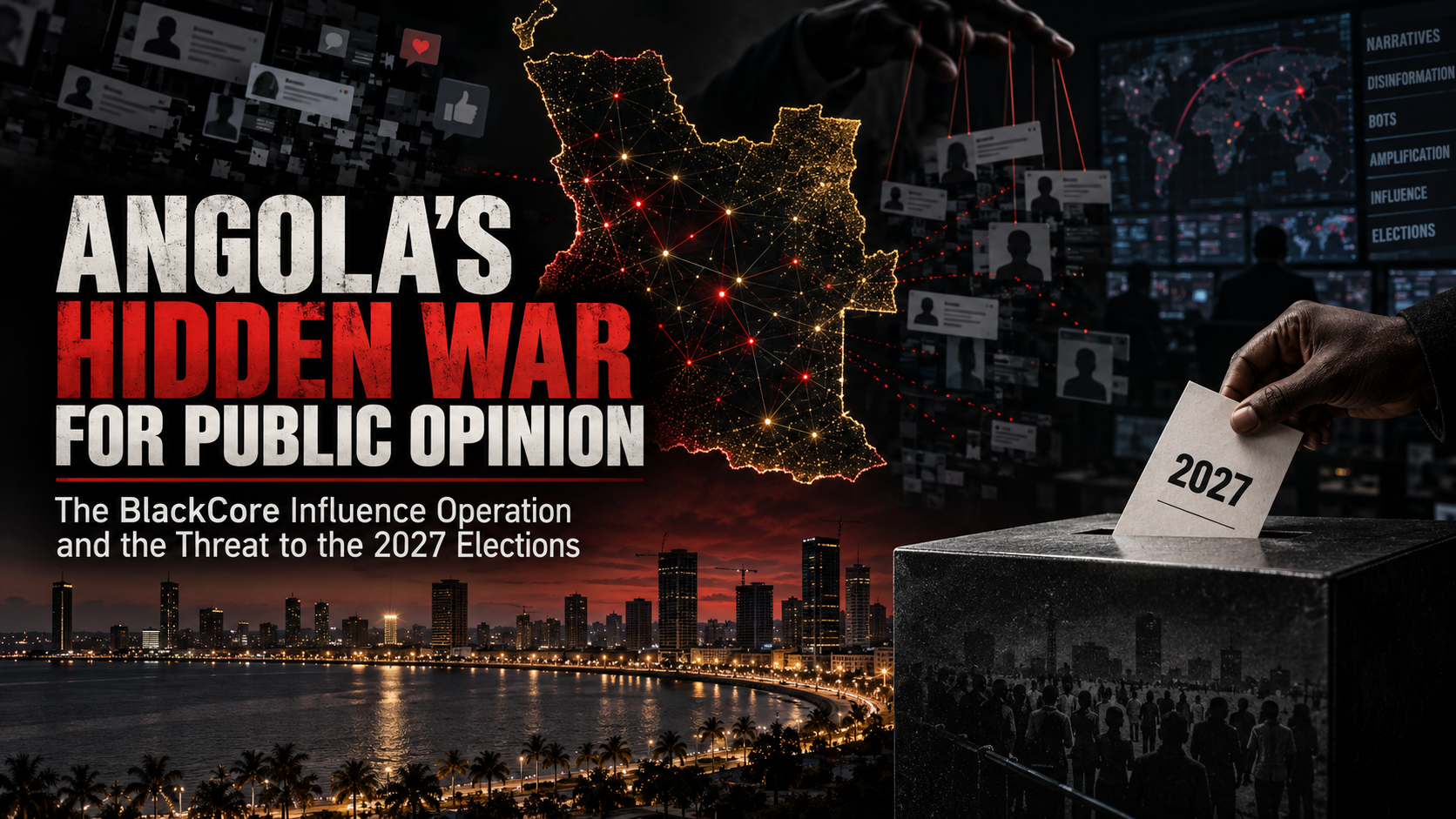
The BlackCore revelations show how covert digital manipulation can become an instrument of state power ahead of the 2027 elections
By Friends of Angola
A government’s duty is to communicate with its citizens. It is not to manufacture citizens, invent news outlets, conceal the origin of political messages or secretly engineer public opinion. Yet a new investigation by the University of Toronto’s Citizen Lab presents disturbing evidence that an Israeli influence-for-hire company, BlackCore, provided Angolan government employees with training that included a supervised online influence operation.
The findings should trigger an immediate, independent investigation in Angola. They are not merely a story about questionable public relations. They concern the possible use of state authority and public resources to build covert systems of political persuasion at a moment when the country is moving toward the 2027 general elections. If left unanswered, the revelations will deepen public distrust and make an already unequal political arena even less credible.
What Citizen Lab uncovered
Citizen Lab identified a BlackCore subdomain titled “Angolan Government Campaign.” The page advertised a multiweek course for the Angolan government in storytelling, copywriting, traffic management and social-media operations. Its stated objective was to replace “amateur production practices” with a professional and scalable architecture for state communications. The proposed program included live campaigns on Meta and TikTok.
Materials later obtained and assessed by the researchers appear to show that the program went well beyond an ordinary communications workshop. According to a BlackCore final report, the initiative began on 19 January 2026 and continued for more than 14 weeks, ending at an unspecified date in April. It generated more than 40 pieces of content, included the evaluation of at least 24 trainee publications and involved live online assets.
At the center of the documented activity was “Agita News,” presented as a news outlet but described by Citizen Lab as made-up. Content was seeded through deceptive online identities, supported by an external website and amplified through reposting in Facebook groups. The campaign then measured views, traffic and engagement and adjusted its approach. Two identified Facebook personas, “Dorivaldo Kiala” and “Gancho Atalaia,” appeared to be fictitious and likely used artificial-intelligence-generated profile images.
This is the familiar machinery of a covert influence operation: disguise the sponsor, manufacture apparent authenticity, distribute coordinated messages and convert artificial amplification into perceived public support. Some deceptive posts reportedly received around 20,000 likes, while posts that remained visible later approached 50,000 engagements. In a country with an estimated six million active Facebook users, those are not trivial figures.
The evidence is serious and its limits matter
The findings must be described precisely. Citizen Lab did not identify the Angolan employees who were reportedly trained, the BlackCore trainers or the government institution that commissioned or paid for the program. The researchers also state that they could not independently confirm that the training occurred. However, after comparing the campaign website, the final report, the dates, promised deliverables, account aliases and online assets, they assessed it as highly likely that the program happened as BlackCore described.
That distinction is important. Responsible scrutiny does not require exaggeration. The documented infrastructure and corroborating assets are already serious enough to demand official answers. The burden now falls on the Angolan authorities to disclose whether any ministry, presidency unit, security body, public company or contractor retained BlackCore or a local intermediary; how much was paid; which officials participated; what data were collected; and whether the operation remains active.
From public communication to covert manipulation
Governments are entitled to explain public policy, correct factual errors and buy clearly labeled advertising. Democratic communication becomes manipulation when the state hides its hand, impersonates independent citizens or media, and uses coordinated fake accounts to create the illusion of spontaneous support. The difference is disclosure, authenticity and accountability.
A public information campaign says who is speaking and allows citizens to evaluate the message accordingly. An influence operation seeks to prevent that evaluation. It treats people not as citizens capable of judgment, but as targets whose perceptions can be shaped without their knowledge. When government personnel acquire these capabilities, the line between public service and partisan advantage can disappear quickly—especially in a system where the ruling party and the state have long been difficult to separate.
BlackCore’s own commercial language makes the democratic risk plain. Citizen Lab found that the company marketed “discourse dominance,” artificial amplification and operations intended to disrupt dissenting narratives. Even if the Angola program was formally framed as “positive government campaigns,” the same infrastructure can be repurposed to crowd out criticism, harass opponents, distort public debate or fabricate consent. A tool designed to manipulate attention does not become democratic simply because its message is positive.
A wider system of digital control
The BlackCore findings should not be viewed in isolation. Angola’s digital civic space is already under pressure from restrictive laws, prosecutions linked to online expression and expanded state powers over communications. Freedom House’s 2025 assessment classified Angola’s internet as only “Partly Free” and noted that the 2024 National Security Law permits restrictions on telecommunications services in vaguely defined exceptional circumstances while expanding surveillance authority.
In February 2026, Amnesty International reported the first forensic confirmation of Predator spyware being used in Angola. The target was journalist and press-freedom advocate Teixeira Cândido, whose phone was successfully infected in May 2024 after a sender posing as an interested student built trust and delivered malicious links. Amnesty could not attribute the attack to a specific government customer, but the case demonstrated that mercenary surveillance technology had reached Angola and was used against a prominent journalist.
Taken together, these cases reveal complementary dangers. Spyware can penetrate the private communications of a critic. Covert influence networks can pollute the public information space around that critic. One watches and intimidates; the other distracts, discredits and manufactures competing narratives. Whether or not the same actors were involved, both markets sell powerful governments a shortcut around democratic accountability.
The contradiction with Angola’s own fake news law
The alleged BlackCore operation is especially troubling when measured against the standards established by Angola’s own Law Against False Information on the Internet, Law No. 6/26 of 4 August 2026. The legislation was proposed by President João Lourenço’s executive and approved in the National Assembly with the support of the ruling MPLA. The final vote was 105 in favor, including the MPLA, PRS and PHA, and 72 against from UNITA. The MPLA defended the measure as an important protection for democratic order, social stability and the integrity of information online.
The methods documented by Citizen Lab closely resemble conduct that the new law itself identifies as dangerous. Law No. 6/26 defines an “inauthentic account” as an account created or used to spread disinformation or impersonate another person in order to deceive the public. It defines an “artificial dissemination network” as a coordinated network operated by people, groups, a company or a government to obtain financial or political advantage. It also prohibits inauthentic accounts, artificial networks that propagate disinformation and sponsored content that is not clearly labeled.
The contradiction is difficult to ignore. The same governing party that supported a law presented as a defense against manipulation must now answer credible evidence that government employees were reportedly trained to use fabricated personas, a disguised news outlet and coordinated amplification. If the law is intended to protect the democratic process rather than police criticism, its principles must apply to state institutions and governing-party interests with at least the same rigor applied to journalists, activists, opposition figures and ordinary citizens.
The timing requires legal precision. The BlackCore program reportedly operated from January through April 2026, while Law No. 6/26 was published on 4 August 2026. The law therefore cannot simply be applied retroactively to impose liability for earlier conduct. But the political and institutional contradiction remains, and any continuation, retention or reactivation of the network after the law entered into force would warrant scrutiny under its provisions. The government should disclose whether the operation continued beyond April, whether its accounts or data remain under official control, and how it intends to comply with the law’s requirement that state-sponsored and paid content be transparently labeled.
The stakes for the 2027 elections
Angola’s next general elections will unfold in a highly networked information environment, with growing use of artificial intelligence and weak safeguards against coordinated inauthentic behavior. Political competition cannot be free and fair if state institutions possess hidden, professionally managed networks capable of impersonating voters, creating false media brands and amplifying preferred narratives at scale.
The immediate harm is not limited to people who believe a particular false story. Covert influence operations corrode the information environment itself. Once citizens suspect that every activist, commentator or news page may be fabricated, authentic voices also lose credibility. That generalized distrust benefits those who already control the institutions, public media, procurement systems and security apparatus. Confusion becomes a political resource.
There is also a financial question. Angola faces profound social needs and persistent demands for transparency in public spending. If public funds financed this program, citizens have a right to know the contract value, procurement method, legal basis, beneficiary institution and intended public purpose. Secret payments for political manipulation would represent not only an attack on democratic participation, but also a misuse of resources entrusted to the state.
What accountability requires
First, the National Assembly should establish a public inquiry with authority to obtain contracts, invoices, procurement records, communications and the list of participating officials. Its work must examine direct engagements as well as subcontracts and local intermediaries. Any inquiry controlled exclusively by the executive would lack credibility.
Second, the government should preserve and disclose all relevant records and publicly state whether BlackCore, its affiliates or intermediaries received state funds. The Tribunal de Contas and the Office of the Attorney General should examine compliance with procurement, public-finance, data-protection and electoral laws. If political parties benefited, the competent electoral authorities should investigate undeclared support and the misuse of state resources.
Third, Meta, TikTok and other platforms should preserve evidence, notify users exposed to coordinated deceptive activity where appropriate, and publish Angola-specific findings. Removing accounts is insufficient when the public cannot learn who operated the network, whom it served and how far it reached. Researchers and credible civil-society organizations should receive privacy-respecting access to relevant platform data.
Fourth, Angola needs enforceable rules requiring clear labels on state-sponsored digital communication, disclosure of government advertising and communications contracts, a prohibition on state use of fake personas, and meaningful penalties for officials who deploy public resources for covert partisan influence. These protections must be written narrowly so they cannot be turned into new censorship powers against journalists, activists or ordinary users.
Finally, civil society and independent media must invest in coordinated monitoring, fact-checking, digital forensics and public education before the electoral campaign accelerates. Citizens should learn to examine page histories, advertising disclosures, recycled content, sudden coordinated amplification and accounts built from synthetic images. Resilience begins when manipulation is recognized early and exposed publicly.
The government must answer
This case is ultimately about the relationship between the Angolan state and its citizens. A government confident in its record should not need fabricated supporters or disguised media. It should defend its policies openly, submit its claims to scrutiny and accept that disagreement is part of democratic life.
Citizen Lab has provided enough evidence to make silence untenable. The Angolan government should identify the institutions and officials involved, disclose the financing and scope of the program, and permit an independent investigation. BlackCore and any intermediaries should also explain their roles and provide the names of their clients and subcontractors, subject to lawful oversight.
Angolans have already paid a high price for opacity in public finance, surveillance and political decision-making. They should not also be forced to navigate a public sphere secretly populated by state-trained personas and manufactured news brands. Before 2027, Angola must choose whether digital technology will widen democratic participation or industrialize political deception. The first step is the truth about BlackCore.
Sources
Citizen Lab. “BlackCore’s Influence Operations for Hire.” University of Toronto, 17 September 2026. https://citizenlab.ca/research/blackcores-influence-operations-for-hire/
Freedom House. “Angola: Freedom on the Net 2025.” https://freedomhouse.org/country/angola/freedom-net/2025
Amnesty International. “Angola: Prominent journalist hacked with Predator spyware.” 18 February 2026. https://www.amnesty.org/en/latest/news/2026/02/angola-spyware/
Angola. Law No. 6/26 of 4 August 2026, Law Against False Information on the Internet. Diário da República, First Series, No. 146. https://lex.ao/docs/assembleia-nacional/2026/lei-n-o-6-26-de-04-de-agosto/
Angola 24 Horas. “Parlamento angolano aprova lei contra ‘fake news’ com votos contra da UNITA.” 21 May 2026. https://angola24horas.com/politica/item/34374-parlamento-angolano-aprova-lei-contra-fake-news-com-votos-contra-da-unita