
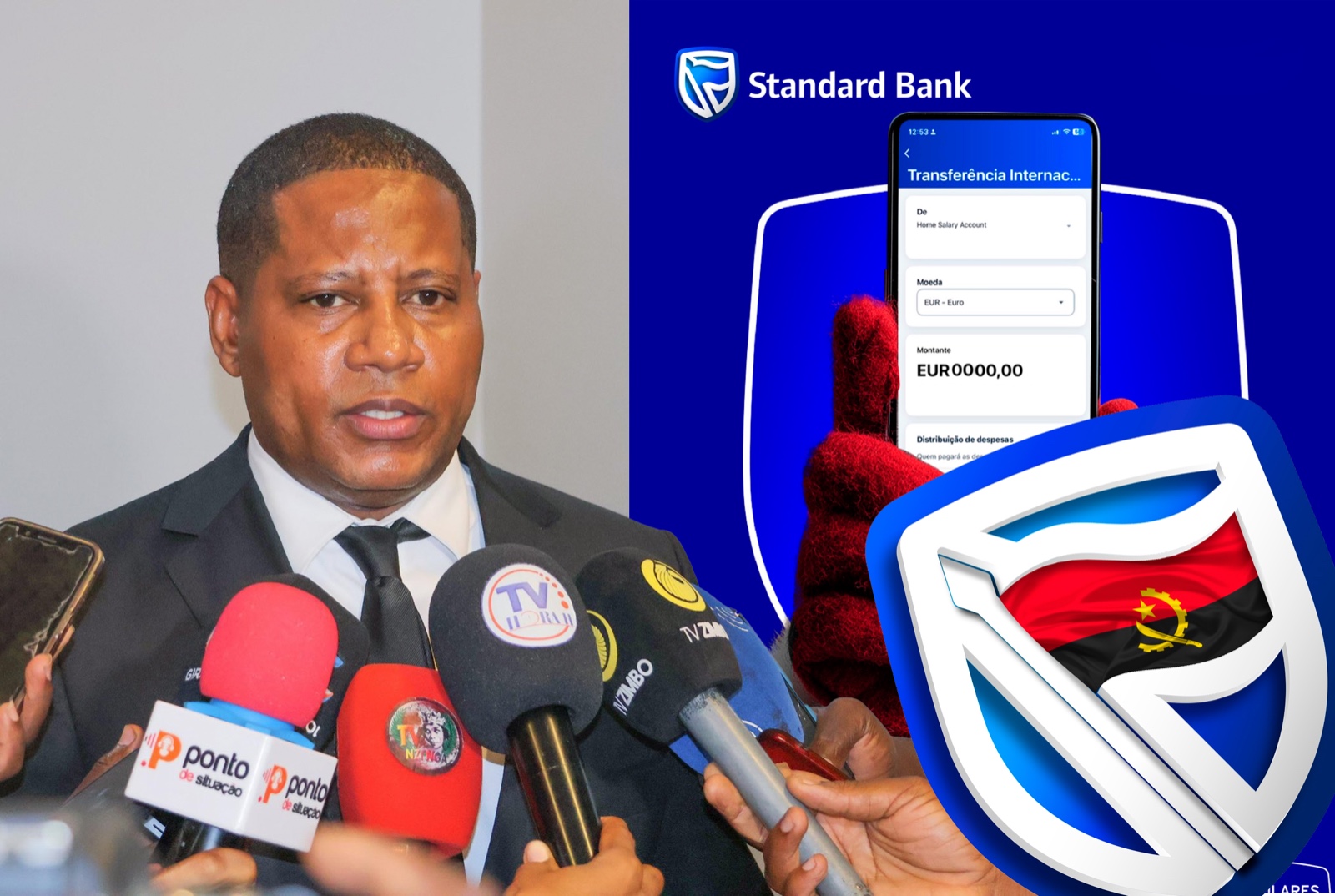
The unexplained withholding of USD 10,000 leaves a family in uncertainty and exposes a possible pattern of repression against civil society.
By Rádio Angola
Just days before the festive season, an Angolan family faces uncertainty and distress due to the complete lack of response from Standard Bank Angola, which has failed to clarify the whereabouts of an international transfer of USD 10,000 for more than 53 days. Beyond raising serious concerns about the bank’s transparency, the case emerges at a time when signs of repression against activists and independent organizations are growing across the country.
Transfer confirmed, money not credited
On October 17, 2025, Florindo Chivucute—activist and Executive Director of Friends of Angola (FOA)—sent a transfer of USD 10,000 from his U.S. bank, Navy Federal Credit Union, to his personal account at Standard Bank Angola. The international SWIFT MT103 receipt confirms that the funds arrived at their destination.
However, more than 53 days later, the amount had still not been credited. The complaints submitted by Chivucute generated only automatic replies, the creation of multiple internal reference numbers, and even the closure of complaint processes without any explanation about the location of the funds.
International tracking confirms Standard Bank Angola’s responsibility
According to official information from Navy Federal Credit Union and the corresponding bank Wells Fargo, SWIFT GPI tracking confirms that:
-
the funds did reach Standard Bank Angola;
-
there is no block, return, or technical error in the international banking system;
-
Standard Bank Angola has not responded to formal inquiries from U.S. banks.
In short, the USD 10,000 are under the direct responsibility of Standard Bank Angola, which has so far failed to provide any plausible justification to the customer.
A financial case within an environment of intimidation
The episode becomes even more serious when viewed against Angola’s current political context. Chivucute’s trajectory—leading an NGO focused on human rights and good governance—has been marked by documented instances of repression.
-
Before the 2022 elections, the activist received multiple death threats while conducting consultancy work for the International Republican Institute (IRI).
-
In 2024, while filming alleged police abuses, he was detained, assaulted, threatened with death, and prevented from accessing justice, according to independent reports.
-
In November 2025, Friends of Angola denounced the persecution and travel ban imposed on seven young activists—an episode widely reported by international media.
Since returning to Angola after nearly two decades in the United States, where he completed his academic training, Chivucute has faced persistent institutional pressure. The magazine Africa Intelligence identified Friends of Angola as one of the organizations whose reporting contributed to U.S. sanctions against high-ranking figures such as generals Kopelipa and Dino—something that heightened scrutiny and tension around the activist.
Institutional contradiction
The unjustified withholding of funds occurs at the same time that Standard Bank Angola publicly celebrates approval to open a correspondent account with J.P. Morgan, touted as a milestone in Angola’s reintegration into the global financial system.
Yet the contradiction is evident:
How can a banking institution claim adherence to international standards while failing to respond to correspondent banks such as Wells Fargo, withholding client funds, and closing complaints without resolution?
The discrepancy between discourse and practice raises serious concerns about Standard Bank Angola’s transparency, operational capacity, and institutional credibility.
“It is not just failing one client” — warns Florindo Chivucute
According to the activist:
“When a bank receives an international transfer, does not credit it, does not return it, ignores international communications, and closes complaints without resolution, it is not only failing a client. It is undermining the credibility of the Angolan financial system.”
Chivucute states that the impacts extend to:
-
investor confidence,
-
the flow of remittances from the diaspora,
-
Angola’s international reputation,
-
and the legal security of banking operations.
Formal requests to the authorities
Given the institutional silence, Florindo Chivucute urges the competent authorities to require Standard Bank Angola to:
-
provide documentary proof identifying the whereabouts of the USD 10,000;
-
immediately credit the funds or formally prove that they were returned to the originating bank;
-
offer clear explanations for the lack of response to Wells Fargo;
-
allow for an independent audit or intervention by the National Bank of Angola.
Transparency is not proclaimed — it is practiced
The protection of citizens’ rights—financial, civil, and political—requires responsible banking institutions aligned with international standards of integrity. In a country where confidence in the financial system remains fragile, cases like this raise serious questions about the safety and transparency of banking operations.
“Confidence is not declared; it is built with transparency, accountability, and truth.” — concludes Florindo Chivucute.